 Giả lập tia quang học
Trình mô phỏng & sáng tạo quang học 2D .
Hoàn toàn miễn phí trên nền tảng web. Mã nguồn trên GitHub.
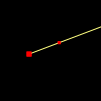
Nguồn một tia
Nguồn một tia đi qua 2 điểm.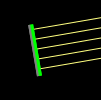
Nguồn tạo chùm tia
Một đoạn thẳng tạo ra chùm tia (song song hoặc phân kì), mật độ tia được điều khiển ở mục 'Mật độ tia'.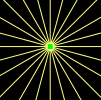
Nguồn sáng điểm
Các tia sáng được phát ra từ một điểm, mật độ tia được điều khiển ở mục 'Mật độ tia'.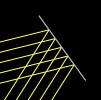
Gương
Mô phỏng phản xạ gương.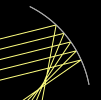
Gương (Gương cong)
Gương cong. Có thể là cầu, parabol tròn xoay hoặc hàm số y =f(x).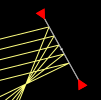
Gương cầu lý tưởng
Gương cầu có bán kính khẩu độ rất nhỏ so với bán kính cong, xác định qua phương trình 1/p + 1/q = 1/f. Tiêu điểm gương có thể được xác định trực tiếp.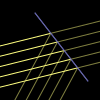
Gương bán mạ
Gương cho phép tia sáng có thể truyền qua một phần và phản xạ một phần.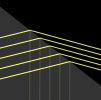
Mặt lưỡng chất
Mô phỏng khúc xạ của ảnh sáng khi qua mặt lưỡng chất.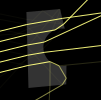
Mặt lưỡng chất (Một số hình dạng khác)
Mặt lưỡng chất có hình dạng bất kì, được xác đỉnh bởi bất đẳng thức f(x)<y<g(x).
Gradient-index material
Material with a custom refractive index function n(x,y).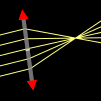
Thấu kính mỏng
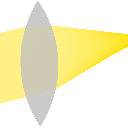
Thấu kính mỏng, xác định theo phương trình 1/p + 1/q = 1/f. Tiêu điểm có thể được xác định trực tiếp.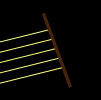
Tấm chắn
A line-segment light blocker which absorbs the incident rays.
Diffraction Grating
A diffraction grating that splits light at an angle depending on wavelength.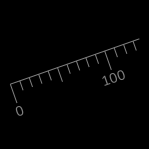
Ruler
A ruler from a point for zero and another point.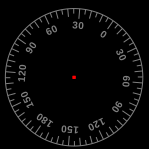
Protractor
A protractor defined from the center and another point for the zero direction. The scale is in degrees.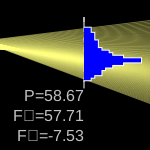
Detector
A tool for measuring the rate of energy flow (P), the rate of perpendicular momentum flow (F⊥), and the rate of parallel momentum flow (F∥) through a line segment. The units are arbitrary.Rays
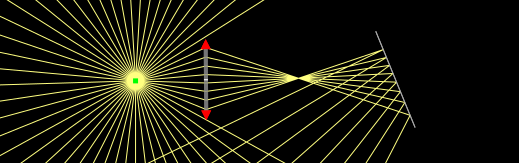
Show the rays. When the 'Ray density' is high, they appear to be continuous.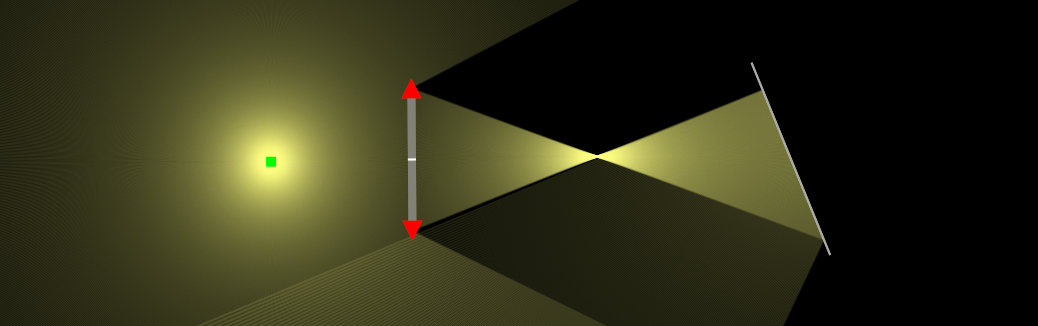
Extended rays
Show both the rays and its extension. Orange indicates backward extensions, and gray indicates forward ones.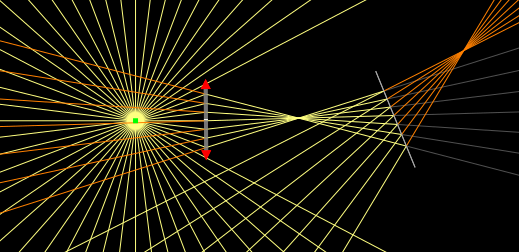
All Images
Show the position of all images and caustics. Yellow points indicate real images, orange indicates virtual images, and gray (none in this picture) indicates virtual objects. Note that some images cannot be detected if 'Ray density' is not high enough.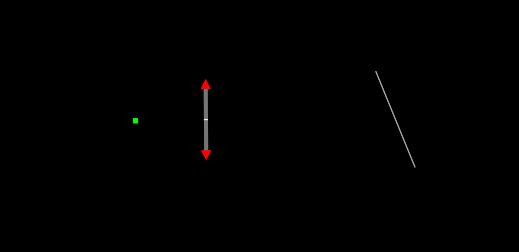
Seen by Observer
Simulate the rays and images seen from some position. The blue circle is the observer. Any rays crossing it are considered to be 'observed'. The observer does not know where the rays actually begin, but may think they begin at some point(s) if they intersect there. The rays are shown in blue, and the points in yellow (real) or orange (virtual).
Simulate Colors
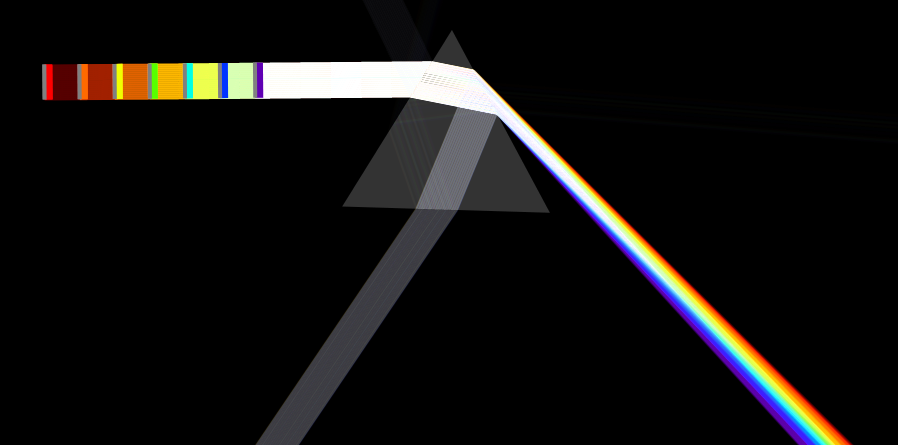
Simulate colors (wavelengths) of light sources, mixture of colors, color filtering of blockers and mirrors, and chromatic dispersion of glasses.